Chichen Itza information

Who built it, how the Maya lived there, what its buildings mean, and what to know before you go. A guide to understanding Chichen Itza in Mexico, the most famous sacred city in Yucatan.

Founded
Around the 6th century AD
UNESCO World Heritage
Since 1988
New 7 Wonders
Since 2007
Location
Yucatán, Mexico
The Pyramid of Kukulcán at Chichén Itzá under a blue sky
Sacred cityMayan pilgrimage center

About Chichen Itza

Chichen Itza is one of the most important archaeological sites on the Yucatan Peninsula and the best-known Mayan city in Mexico. It was a political capital, a trading hub, and a sacred city that drew pilgrims from across the Mayan world, and it still holds that role for many Maya today.

Its name describes the place: chi means mouth, chen means well, and the Itza were the group that settled here. Together, Chichen Itza means "at the mouth of the well of the Itza". The well is the Sacred Cenote, the natural sinkhole at the north end of the city. The name Itza is often translated as "water sorcerers".

How big is Chichen Itza?

At its height, the city covered about 10 square kilometers (4 square miles) and may have been home to some 35,000 people. The area open to visitors today is much smaller and can be walked in two to three hours. El Castillo, its main pyramid, rises 24 meters (79 feet) to the top platform, and about 30 meters (98 feet) with the temple on top.

How the city was organized

At the top of society was the ruler, who governed together with priests and nobles. The elite included scribes, architects, treasurers, and warriors, roles you can still see in the murals, carved reliefs, and pottery found at the site.

Farmers, weavers and artisans lived in the villages around the city. They came in for the market and for the religious ceremonies that followed the Mayan calendars.

The two Mayan calendars

The Maya kept two calendars at the same time: a solar calendar of great astronomical precision, and a ritual calendar used for divination. Together they formed a 52-year cycle, the Mayan equivalent of our century.

  • 365Days in the solar calendar (Haab') 18 months of 20 days, plus 5 "nameless" days called Wayeb
  • 260Days in the ritual calendar (Tzolk'in)20 day names combined with the numbers 1 to 13, used for divination
  • 52Years in the Calendar RoundThe time it takes both calendars to line up again

Religion and the Sacred Cenote

Religion shaped daily life, and the Mayan gods were tied to the forces of nature, above all rain. Chichen Itza remained a place of pilgrimage even after its decline. The Sacred Cenote is proof of that: divers and archaeologists have recovered offerings of gold, jade, shell, and wood from its waters, along with human remains from sacrifices.

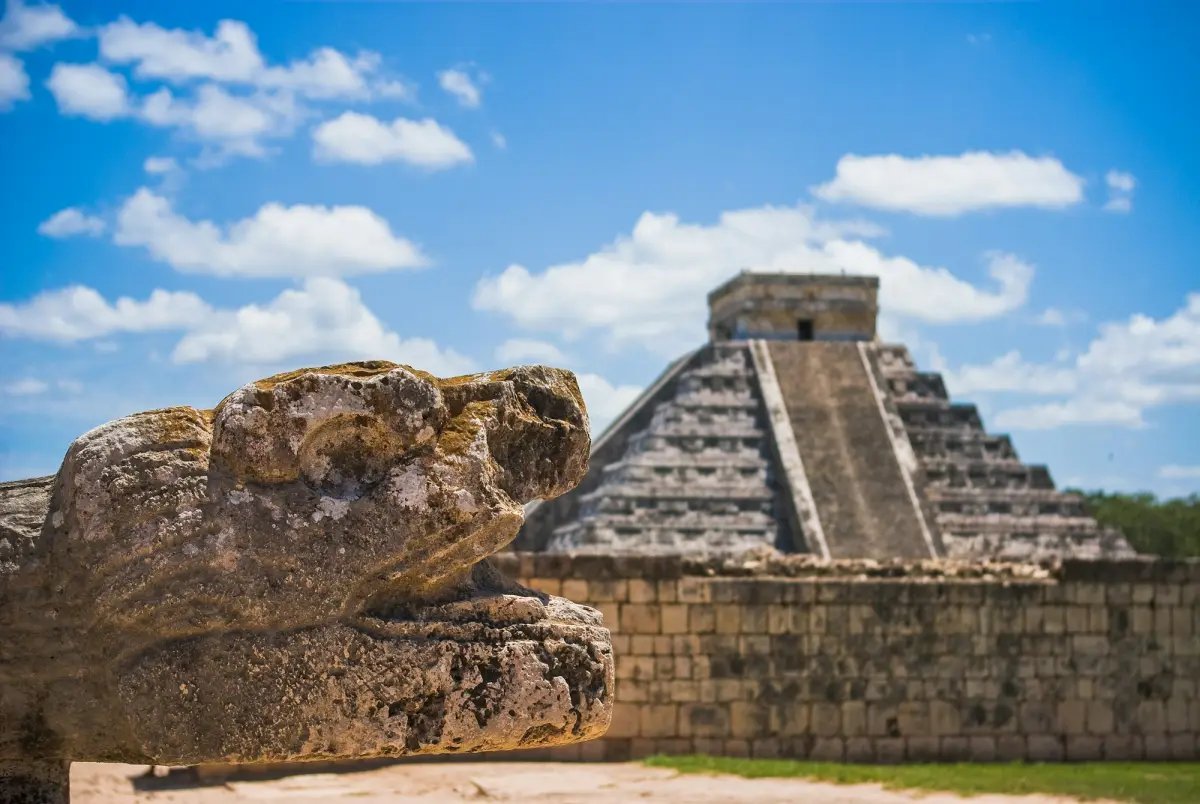
The Pyramid of Kukulcán at Chichén Itzá, seen among agave plants under a clear sky
Inside the older pyramid hidden beneath El Castillo, archaeologists found a disk of turquoise and shell mosaic set on wood, part of an offering. It is now on display at the National Museum of Anthropology in Mexico City.

Plan your visit

The practical side: what it costs, where it is, and what to see beyond the ruins by day.

  • The Pyramid of Kukulcán at Chichén Itzá, seen among agave plants under a clear sky

    Entrance fee

    As a World Heritage Site and one of the New 7 Wonders of the World, Chichen Itza charges every visitor an entrance fee. That money helps maintain the site and supports the nearby communities.

    See prices and hours
  • Light and sound show

    Light and sound show

    After dark, the face of El Castillo lights up with images and effects that tell the story of the city, with narration and music.

    Show times and prices
  • Equinox at Chichen Itza

    Equinox at Chichen Itza

    At the equinoxes, day and night last almost the same time; the word comes from the Latin for "equal night". At Chichen Itza, the afternoon sun draws a serpent of light and shadow that seems to slide down the stairs of El Castillo.

    Read the equinox guide

Where is Chichen Itza?

Chichen Itza is in the state of Yucatan, in southeastern Mexico, roughly halfway between Cancun and Merida. Most visitors come from Cancun, the largest city in the region.

  • From Valladolid45 min
  • From Merida1 h 30 min
  • From Cancun2 h 30 min

Chichen Itza history

Dating the history of Chichen Itza is hard: there are few written records, and the Mayan calendar reused the names of dates in each cycle. Even so, archaeologists recognize two main stages in the city's life.

  1. About 3,000 years ago

    Mayan civilization

    The Maya emerged in what is now Mexico, Guatemala, Belize and Honduras. Their southern cities flourished between about 250 and 900 AD and then collapsed. No one knows for certain why.

  2. From the 6th century AD

    Chichen Viejo

    The oldest part of the city, built in the Puuc style of western Yucatan. Its facades are covered with masks of Chaac, the Mayan rain god.

  3. From about 900 AD

    New Chichen

    The city grew into a regional capital with strong ties to central Mexico. This stage is marked by Kukulkan, the feathered serpent, and buildings such as El Castillo and the Temple of the Warriors.

The ruins and their conservation

The buildings of Chichen Itza are among the most impressive in the Mayan world.

The main buildings

The best-known is El Castillo, the Temple of Kukulkan, the symbol of the city, which was voted one of the New 7 Wonders of the World in 2007. Around it stand the Great Ball Court, the Temple of the Warriors, El Caracol, and the Platform of the Eagles and Jaguars.

Why you can no longer climb the pyramid

Chichen Itza is one of the two most visited archaeological sites in Mexico and is open 365 days a year. On busy days, it receives more than 8,000 visitors. Years of climbing wore down the stone, so since 2006 visitors are no longer allowed to climb El Castillo or the other monuments.

What Chichen Itza looked like before

When explorers reached the site in the 19th century, most buildings had collapsed and were covered by jungle. Large-scale excavation and restoration began in the 1920s, and much of what you see today was rebuilt between the 1920s and 1940s. Originally, many buildings were plastered and painted in bright colors, mainly red, blue, and yellow.

See what to visit inside the site

Explore it with someone who knows the story

On our tours, a certified guide explains the history of each building, with your Chichen Itza ticket already included.

See Chichen Itza tours

FAQs

Chichen Itza FAQs

What was Chichen Itza used for?

It was a political capital, a center of trade, and a sacred city. Pilgrims traveled there to leave offerings at the Sacred Cenote, and its temples, ball courts, and observatory were used for ceremonies, games, and tracking the sky.

Who built Chichen Itza?

The Maya. The city was settled around the 6th century AD and later took its name from the Itza, the group that ruled it at its peak.

Where is the Chichen Itza pyramid in Mexico?

In the state of Yucatan, about 200 km (125 miles) west of Cancun and 120 km (75 miles) east of Merida.

What is Chichen Viejo?

The oldest part of the city, south of the main plaza, with Puuc-style buildings decorated with masks of the rain god Chaac. It opened to visitors in 2023.

How long do I need to visit Chichen Itza?

Two to three hours are enough to see the main buildings. Add another hour if you want to walk to Chichen Viejo.