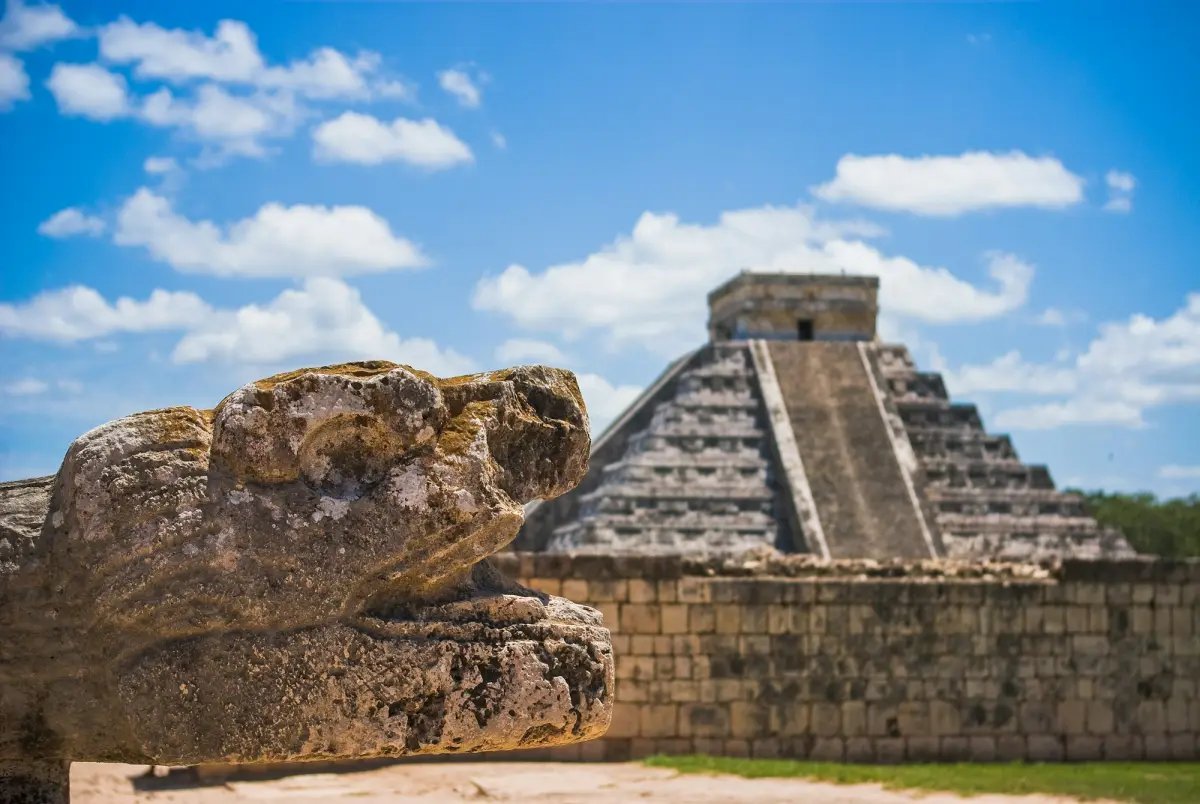
The buildings of Chichen Itza are some of the finest the Maya ever made, and one of them, El Castillo, is a New Wonder of the World. But this city is much more than its pyramid. Here are its temples one by one: where they are and what story each one tells.
Buildings in this guide
19
City stages
Old and New Chichen
Styles
Puuc, Chenes and Maya-Toltec
Walking tour
3 to 4 hours
New Wonder of the WorldPyramid of Kukulkan
1
The Pyramid of Kukulkan, El Castillo
Height
30 m (98 ft) with the temple
Steps
365 in total
Stage
New Chichen
It is the best-known temple in Mexico and the clearest example of Mayan architecture at its peak. The Itza built it over an older pyramid that is still preserved inside.
It has four sides, each with a stairway, and on top a rectangular temple dedicated to Kukulkan, the feathered serpent.
A calendar made of stone
The pyramid works as a solar calendar. Each stairway has 91 steps; add the top platform, and you get 365, one for each day of the year. At the equinoxes, the shadow of its nine terraces draws a serpent that slides down the north stairway to the carved head at its base.
What's inside the Chichen Itza pyramid
In the 1930s, archaeologists found a staircase under the north side and followed it to an older pyramid hidden inside. Its temple held a Chac Mool and a red jaguar throne with jade spots. In 2016, scans revealed a third, smaller pyramid at the core, built centuries earlier. The tunnel has been closed to visitors since 2006.
The wide esplanade around El Castillo is the heart of New Chichen. Here you'll find the ball court, the ceremonial platforms and the white road, or sacbe, that leads to the Sacred Cenote.
2
The Great Ball Court
Court
168 m (551 ft) long
Use
Ritual
Every Mesoamerican culture played the ball game, and this is the largest court ever found. Two long walls frame the field, with a stone ring set high on each side. For the Maya of Chichen Itza, the game was closer to a ceremony than a sport: it probably reenacted the mythical struggle between night and day.
An echo from end to end
The court has a surprising acoustic effect. A voice in the temple at the south end can be heard clearly at the north end, as the sound travels along the walls. Guides often clap to show you.
3
The Tzompantli
Also known as
Platform of the Skulls
A wide, low platform covered with rows of skulls carved in relief, which give it its name. The carvings are arranged in panels separated by moldings. In central Mexico, similar platforms were used to display the skulls of sacrificed captives.
4
The Platform of the Eagles and Jaguars
Stairways
4
A small platform with a stairway on each side. Its panels tell the daily journey of the sun across the sky and its descent into the underworld at night. The eagles and jaguars holding human hearts stand for the warrior orders that captured offerings for the sun god.
5
The Venus Platform
Stairways
4
A square platform on the road to the Sacred Cenote, also with four stairways. Its reliefs show Venus as a "knot" of years, next to a half flower and the woven mat, or pop, a symbol of power. In the recessed panels, Venus emerges with jaguar claws from the jaws of a feathered serpent.
6
The Temple of the Warriors
Height
12 m (40 ft)
Width
40 m (131 ft)
A reclining Chac Mool sculpture waits at the top of the stairs, and the walls are carved with warriors, eagles and jaguars eating human hearts, and the god Tlalchitonatiuh, the "sun of the earth".
7
The Group of a Thousand Columns
Built
900 to 1200 AD
A huge square courtyard lined with rows of carved columns that once held up a roof. On the west side are the remains of four chambers; two were filled in to support a second floor. Some columns still keep traces of the painted stucco that once covered them.
8
The Market
Platform
81 x 15 m (266 x 49 ft)
Tradition calls this long, narrow building "the Market", although its real use is unknown. A central stairway with balustrades leads up to a row of round pillars that alternate with square ones.
9
The Steam Bath
Use
Temazcal (steam bath)
Part of its flat roof still stands, along with four portico columns and stone benches against the front wall. A low, narrow doorway leads to the inner chamber, where bathers sat on stone benches around the heat.
10
The Sacred Cenote
Diameter
about 50 x 61 m (165 x 200 ft)
A natural open sinkhole connected to the Great Platform by a white road, or sacbe. As part of the cult of the rain god, the Maya threw precious objects into its water as offerings, and later also human sacrifices.
The Ossuary Group
South of the Great Platform, the path runs between smaller buildings where the styles of the city's two stages mix.
11
The Ossuary
Levels
9
Stairways
4
A nine-level pyramid that looks like a smaller El Castillo. Its four stairways have balustrades carved with intertwined serpents and climb to a temple whose entrance is framed by two serpent columns.
12
The House of the Deer
Its name comes from a painting of a deer that, according to tradition, decorated an inner wall. It is gone now: water probably seeped in and washed away the stucco. Only traces of the roof crest remain.
13
The Chichanchob, or Red House
Style
Puuc
It stands on a rectangular platform with rounded corners. A stairway without balustrades leads to the temple, which has two roof crests, one at the front and one in the middle. Its facade alternates stepped frets with masks of Chaac above the doorways.
14
El Caracol, the Mayan observatory
Height
23 m (75 ft)
Shape
Round tower
Use
Watching the sky
It is one of the few round buildings the Maya made. Priests likely followed the stars through the narrow windows at the top of the tower. It is really three structures stacked together: a round tower on a platform with a central stairway, which sits on a larger rectangular platform.
How it was built
First level
Two circular walls, one inside the other, enclose two round chambers with four doors each.
Second level
A narrower body rises above the cornice, with a frieze showing a Chaac mask and a seated figure among feathers and serpents.
Third and fourth levels
They are damaged, but you can still see the windows that may have tracked the movement of the stars.
On the west side of the base, a stairway with balustrades of intertwined serpents leads up to the tower. It dates from the city's first stage of growth, around the 10th century.
Mayan astronomy
The Maya studied the sun, the moon and Venus, and also tracked Mercury, Mars and other visible stars. Their priests predicted solar and lunar eclipses, the rising and setting of Venus and the length of the solar year with great accuracy.
For them, astronomy and the origin of the universe were part of the same story.
The lords of time
The Maya turned not only time into a god, but also each of the periods they divided it into. These gods kept the universe in order and lived in an endless cycle: they were born, showed their character, died, and were born again.
Old Chichen and the Nunnery
The oldest part of the city. Here the Puuc and Chenes styles dominate, with facades covered in stone mosaics and masks of Chaac, the rain god.
15
The Nunnery
Height
10 m (33 ft)
Style
Chenes
One of the most imposing complexes at Chichen Itza. Its main facade faces north and joins three buildings from different periods: the Nunnery, the East Annex, and the Southeast Annex.
A central stairway on the north side climbs to a richly decorated temple. Spanish explorers saw its many small rooms and thought it had been a convent for priestesses, which is how it got its name.
16
The East Annex of the Nunnery
Style
Chenes
It has the most beautiful frieze at Chichen Itza, covered with masks of the rain god Chaac. Every facade follows the Chenes style.
17
The Church
Rooms
1, vaulted
A small square building with a roof crest and a single room. Its facade has symmetrical stone mosaics, a molding of stepped frets and a frieze with a Chaac mask in the center.
18
Akab Dzib
Rooms
18
It began as a central building with two rooms; later, two wings of eight rooms each were added. All three parts are roofed with the Mayan corbel vault, or false arch. Finely carved stone benches survive on the east facade.
19
The South Group
Built
7th to 10th century
Style
Puuc
A cluster of buildings in the jungle, south of El Caracol and the Nunnery. The most important are the Temple of the Initial Series, the Temple of the Phalli, the Temple of the Owls and the Temple of the Atlantes.
Explore the ruins with a guide
A certified guide walks you through the Great Platform and Old Chichen and tells you the story of each building, with your Chichen Itza ticket already included.
It was a political capital, a trading center, and a sacred city. Its temples were used for ceremonies and offerings, the ball courts for ritual games, El Caracol for watching the sky, and the Sacred Cenote for offerings to the rain god.
Can you go inside the Chichen Itza pyramid?
No. The tunnel to the inner temple of El Castillo was closed to visitors in 2006, the same year climbing was banned. You can see the pyramid from the plaza and learn what's inside from your guide.
What is inside the Mayan pyramid of Chichen Itza?
An older pyramid with its own temple, where archaeologists found a Chac Mool and a red jaguar throne with jade spots. Studies in 2016 also detected a third, smaller pyramid at its core.
What are the most important temples at Chichen Itza?
El Castillo, the Temple of the Warriors, El Caracol, and the Nunnery. Together with the Great Ball Court and the Sacred Cenote, they are the stops every guided tour includes.